Nissan of Roanoke Rapids

Blog / Roanoke Rapids Nissan Dealer

The 2026 Nissan Sentra Buyer's Guide: Specs, Trims, and Smart Features Explained

2026 nissan sentra for sale near me

Key Takeaways

The 2026 Nissan Sentra offers impressive value with segment-leading technology and comprehensive safety features across four distinct trim levels, starting at just $22,600. • All trims include dual 12.3-inch displays and complete Nissan Safety Shield 360 suite as standard equipment • The SV trim at $23,370 provides the best value with wireless connectivity and digital instrument cluster • Sport-focused SR trim adds 18-inch wheels and athletic styling for $25,000 • Premium SL trim delivers ProPILOT Assist, Bose audio, and heated seats for $27,990 • Class-exclusive features include 64-color ambient lighting and myQ garage door opener integration • The 149-horsepower 2.0L engine with improved CVT delivers 30-38 mpg depending on trim selection The Sentra's strength lies in making advanced technology accessible across all price points, with each trim offering clear value propositions for different buyer priorities—from budget-conscious commuters to those seeking premium comfort features. The 2026 Nissan Sentra builds on a proven foundation of more than 40 years in production and over 6.5 million units sold. This redesigned compact sedan offers segment-above features such as class-leading dual 12.3-inch displays, all starting at an MSRP of $22,600. A 149-horsepower engine and four trim levels give you options. Finding the right configuration requires understanding what each model offers. In this piece, I'll break down the nissan sentra trim levels and compare interior features alongside exterior design. I'll explain the smart technology and help you determine which 2026 nissan sentra price point delivers the best value for your needs.

Nissan Sentra Models Overview for 2026

Complete trim lineup breakdown

Nissan offers the Sentra in four distinct configurations for 2026: S, SV, SR, and SL. Each trim shares the same 2.0-liter four-cylinder engine producing 149 horsepower and 146 lb-ft of torque, paired with a continuously variable transmission. The differences emerge in features, styling, and technology packages. The S trim establishes the baseline with 16-inch steel wheels, LED headlights, cloth seating, and a 12.3-inch NissanConnect touchscreen. Remote keyless entry with push-button ignition comes standard, coupled with a four-speaker audio system and a 7-inch multi-information display. Standard safety features have frontal collision mitigation, adaptive cruise control, blind-spot warning with steering intervention, rear cross-traffic alert, lane departure mitigation, and driver attention monitoring. The SV adds 16-inch alloy wheels when you step up. Keyless entry with remote start, automatic climate control, upgraded cloth upholstery, and a digital 12.3-inch instrument panel come with this trim. Wireless connectivity for Apple CarPlay and Android Auto becomes available here. The SR takes a sportier direction with 18-inch alloy wheels, upgraded LED exterior lighting, heated mirrors, and dark exterior accents. Sport cloth seats feature contrasting stitching inside. The trim has rear seat floor air ducts, a wireless charging pad, and a six-speaker audio system. NissanConnect remote monitoring with Wi-Fi hotspot capability also debuts at this level. The SL delivers 17-inch wheels, a sunroof, dual-zone automatic climate control, and quilted synthetic leather seating at the top. The power-adjustable driver's seat has lumbar support. Heated front seats and a heated steering wheel improve comfort. An eight-speaker Bose audio system comes standard, as well as ProPILOT Assist, lane keeping assistance, a surround-view camera system, rear parking sensors, and reverse automatic braking.
Key changes from previous generation

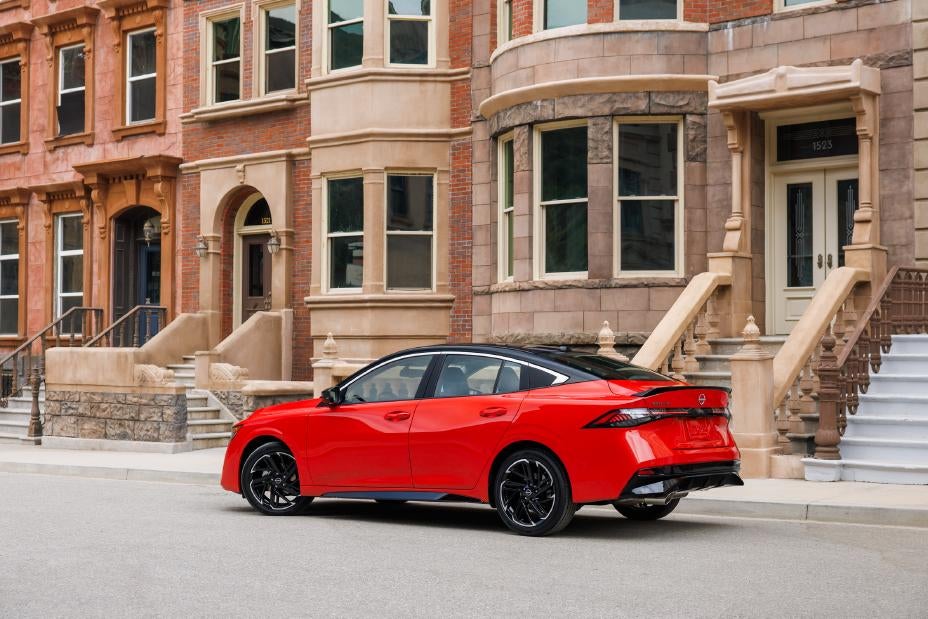
The 2026 model marks the start of the Sentra's ninth generation. The powertrain remains unchanged from the previous generation, but Nissan refined the CVT for smoother shifts and better responsiveness. The suspension received upgraded dampers. This creates a quieter and more composed ride. Design changes extend throughout the exterior. A more pronounced sloping roofline creates a streamlined silhouette, while a wider V-Motion grille framed by sleek LED headlamps defines the front end. Three body-colored accent bars integrate into the front fascia. Sculpted door contours with updated rear detailing deliver a more upscale appearance. The design team incorporated stretched horizontal lines that make the Sentra appear wider and bolder without changing physical dimensions. The cabin benefits from a larger 12.3-inch infotainment touchscreen across the whole lineup. Premium upholstery options appear on higher trims. Features like a heated steering wheel and power sunroof become available on select models. The SL trim returns to the lineup after being absent. It offers quilted TailorFit seating, ProPILOT Assist, and Bose premium audio as standard equipment. Class-exclusive features have 64-color customizable ambient lighting, Intelligent Around View Monitor with Moving Object Detection, and myQ Universal Garage Door Opener.

Starting price and value proposition

The 2026 Nissan Sentra starts at an MSRP of $22,600 for the S trim. The SV is priced at $23,370, while the SR carries a $25,000 sticker. The range-topping SL starts at $27,990. All prices require an additional $1,245 destination charge. The pricing structure reflects a value-oriented approach on the whole. The base S has segment-above features like wireless Apple CarPlay integration and Nissan Safety Shield 360. The SV adds the digital instrument cluster and wireless smartphone connectivity for just $770 more. The SR commands a $1,630 premium over the SV for its sport styling and larger wheels. The SL represents a $2,990 jump from the SR but delivers ProPILOT Assist, premium audio, and safety features that would cost much more as individual options. Fuel economy ratings favor the lower trims. The S and SV achieve EPA-estimated 30 mpg city, 38 mpg highway, and 33 mpg combined. The SR and SL return 29 mpg city, 36 mpg highway, and 32 mpg combined.

Comparing Interior and Exterior Design Across Trims

Cabin materials and seating options

Nissan separated each trim with distinct upholstery choices. The S and SV feature charcoal cloth seats that provide durability for daily use. The SR changes to sport cloth with orange stitching that matches the trim's athletic character. The SL receives TailorFit soft-touch quilted leatherette in black or gray at the top. Heated front seats appear as optional equipment on the S through the Cold Weather Package. They become part of the Convenience Package on the SV and arrive standard on the SL. The SL also has a power-adjustable driver's seat with four-way lumbar support, while the SR offers this as part of its Premium Package. All trims use 60-40 split-folding rear seats. Steering wheel treatments vary by grade. The S uses urethane. The SV offers optional leather wrapping through the Convenience Package, and the SR and SL come standard with leather-wrapped wheels. The SL adds a heated steering wheel as standard equipment.

12.3-inch touchscreen and digital displays

The monolith display layout positions dual 12.3-inch screens across the dashboard width. Every trim receives the 12.3-inch NissanConnect touchscreen. The S uses a 7-inch multi-information display for gages. The SV, SR, and SL upgrade to a 12.3-inch digital instrument cluster. This configuration reduces menu navigation. It keeps navigation prompts, audio details, and driver-assist information visible at the same time. The infotainment screen outputs twice the brightness of the previous generation. Visibility improves in varied lighting. Wireless Apple CarPlay and Android Auto come standard on all grades.

V-Motion grille and exterior styling

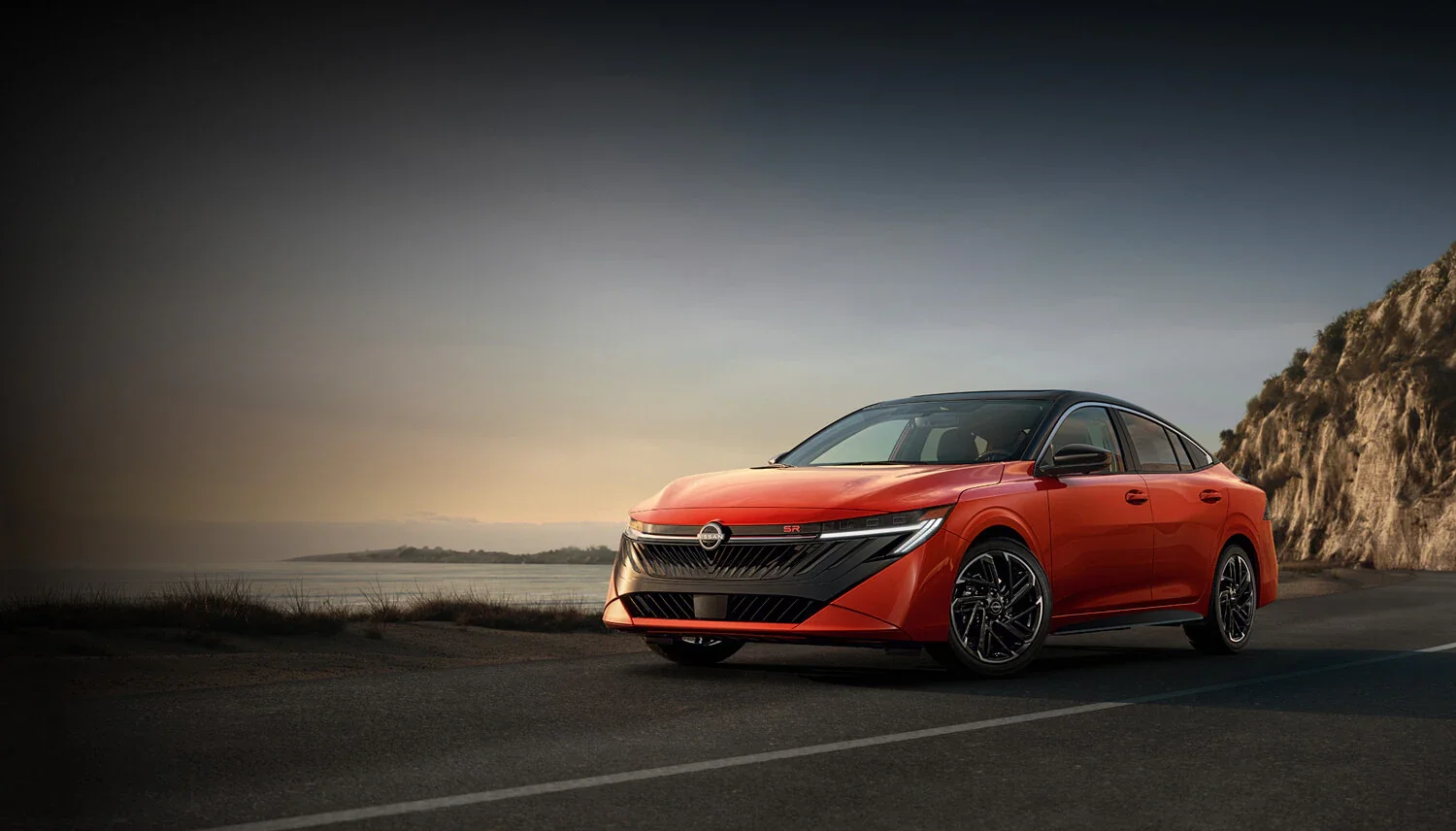
The redesigned front fascia showcases an evolved V-Motion grille with lines that extend into the lighting signature. Slim projector LED headlights deliver boosted output while they maintain a subtle profile. The S and SV feature a black grille with chrome accents. The SR uses a gloss black finish, and the SL returns to black with chrome accents. A lower character line runs horizontally along the body. It creates the visual impression of a reduced center of gravity. The fastback roofline adds a sportier profile, while reshaped rear fenders improve aerodynamics. Two-tone paint options emphasize the updated styling on select configurations.

Wheel options and color choices

Three wheel sizes distinguish the lineup. The S starts with 16-inch steel wheels. The SV moves to 16-inch alloy wheels, the SR jumps to 18-inch alloys, and the SL settles on 17-inch alloys. Each design incorporates intersecting lines that add visual motion. The color palette has Imperial Bronze, Gun Metallic, Atlantic Gray Metallic, Super Black, Scarlet Ember, Aspen White, and Fresh Powder. Four two-tone combinations pair Aspen White, Bluestone Pearl, Atlantic Gray, or Energetic Ember with a Super Black roof.

Cargo space and practical features

The trunk offers 14.3 cubic feet of storage on all trims. Nissan engineered one of the lowest liftover heights in the compact sedan segment. Loading golf bags and strollers becomes simpler. The optimized opening shape accommodates larger items more easily than competitors. Interior volume totals 96.1 cubic feet for passengers. Front occupants access 43.8 inches of legroom and 38.9 inches of headroom without a moonroof. Rear passengers receive 34.9 inches of legroom.

Technology and Smart Features Explained

NissanConnect infotainment system

NissanConnect Services turns the Sentra into a connected hub through the MyNISSAN app. Remote Engine Start with Intelligent Climate Control preconditions the cabin before you reach the vehicle. My Car Finder pinpoints your Sentra's location in crowded parking areas. Remote Vehicle Status monitors tire pressure, lock status and fuel levels from your smartphone. The built-in Wi-Fi Hotspot supports up to seven compatible devices and lets passengers stream content or work remotely without draining phone data. Three USB-C ports provide charging options for front and rear occupants. The center infotainment screen delivers twice the brightness of the previous generation and improves readability in direct sunlight.

Apple CarPlay and Android Auto integration

Wireless connectivity eliminates cable management for both Apple CarPlay and Android Auto in every trim level. Voice control through Google Assistant handles navigation requests, audio adjustments and temperature changes without requiring manual input. The system reconnects after original pairing and displays media and messages within moments of startup. Popular navigation apps including Apple Maps, Google Maps and Waze display on the 12.3-inch screen and respond to voice prompts for address entry and rerouting. Driver profiles store individual-specific settings for up to four users and adjust displays when each driver connects their device.

64-color ambient lighting

Class-exclusive customizable ambient lighting offers 64 color options and allows drivers to match the cabin atmosphere to personal priorities or driving conditions. This feature distinguishes the Sentra from competitors in the compact sedan segment.

Intelligent Around View Monitor

The Intelligent Around View Monitor uses four wide-angle cameras mounted on the front, side mirrors and rear to generate a virtual 360° bird's-eye view. Split-screen displays show rearview and overhead perspectives when backing into parking spaces. The camera button on the center console toggles side views. When you shift into drive, the view switches to front. Moving Object Detection processes camera signals live and issues audio and visual alerts when detecting movement around the vehicle. The system indicates which direction objects approach from and enhances awareness in tight spaces.

myQ garage door opener

The myQ Universal Garage Door Opener operates through the infotainment touchscreen and controls up to three compatible garage door openers. Geofencing functionality displays prompts to open or close doors when approaching or departing saved locations. Drivers can set custom reminders between one and ten minutes after leaving home and receive touchscreen alerts to verify the garage closed securely.

Performance Specs and Driving Experience

149 horsepower 2.0L engine details

Power delivery in the 2026 nissan sentra comes from a 2.0-liter DOHC 16-valve inline-four engine that generates 149 horsepower at 6,400 rpm and 146 lb-ft of torque at 4,400 rpm. Direct injection technology maximizes fuel atomization and maintains responsiveness throughout the rev range. An idle stop/start system cuts the engine at stoplights to conserve fuel during city driving. You release the brake pedal and the system restarts smoothly, contributing to EPA estimates of 29-30 mpg city depending on trim selection. Peak torque arrives at 4,400 rpm. This provides adequate passing power on highways without requiring excessive downshifts.

CVT transmission tuning improvements

Nissan retuned the Xtronic CVT for 2026 to deliver a more natural acceleration feel. The rubber-band sensation common in continuously variable transmissions is reduced with the updated calibration, which creates shift points that mimic traditional automatic gearboxes. Manual mode allows drivers to control simulated gear ratios through steering wheel inputs on select trims. Ground testing shows 0-60 mph times around 8 seconds. Smoothness takes priority over outright performance with the CVT, though engine drone can occur under heavy throttle loads.

Sport mode and paddle shifters

Three drive modes adjust throttle mapping and transmission behavior. Standard mode balances efficiency and response for daily commuting. Eco mode stretches fuel economy by reducing throttle sensitivity. Sport mode, available on SV, SR and SL trims, sharpens throttle response and holds simulated gears longer for a more engaging feel. Nissan tuned Sport mode for U.S. driving conditions. The system provides more immediate throttle response during highway merges and passing maneuvers, though it doesn't add horsepower.

Suspension and ride quality

Independent strut front suspension and multi-link rear geometry with coil springs and stabilizer bars on both ends form the chassis. Nissan reinforced the unibody structure and achieved 6% greater rigidity compared to the previous generation. Noise and vibration intrusion into the cabin is reduced with this stiffening. New shock absorber valving better absorbs impact harshness from road imperfections. An enlarged dynamic damper in the steering wheel filters road vibrations before they reach your hands. Steering ratio quickened from 15.3:1 to 14.0:1 and improves response without sacrificing stability. A balanced setup that handles daily driving without drawing complaints is the result.

Safety Technology and Which Trim to Choose

Automatic Emergency Braking with Pedestrian Detection

Nissan Safety Shield 360 comes standard on all 2026 nissan sentra trim levels. Automatic Emergency Braking with Pedestrian Detection monitors the road ahead and issues audio and visual warnings that detect potential front collisions. The system applies brakes to prevent or reduce the severity of collisions with vehicles and pedestrians automatically.

Lane Departure Prevention and traffic sign recognition

Lane Departure Prevention detects unintentional lane drift and provides steering assistance to maintain lane position. Traffic Sign Recognition appears standard on S and SV trims, while the SR offers it as part of the Premium Package with Automatic Speed Limit Assist. Blind Spot Intervention debuts for the first time and adds steering resistance that detects vehicles in adjacent lanes.

Choosing between S, SV, SR, and SL trims

The S includes essential safety features like blind-spot monitoring and rear cross-traffic alert. The SV and SR share driver-assist capabilities as with each other. The SL stands out with ProPILOT Assist and Lane Keep Assist as standard equipment. ProPILOT Assist is available as an option on SV and SR trims.

Best trim to match your needs and budget

Budget-focused buyers find complete safety protection in the S trim. Commuters benefit from the SV's dual 12.3-inch displays and wireless connectivity. The SR suits drivers wanting sport styling without sacrificing safety technology. The SL delivers premium features to those who prioritize advanced driver assistance and refined comfort.

Conclusion

The 2026 Nissan Sentra delivers segment-above technology and complete safety features at a competitive starting price of $22,600. You can prioritize budget-conscious transportation with the S, improved connectivity through the SV, sport styling via the SR, or premium comfort from the SL. Each configuration offers distinct advantages. The sedan's value shows best in its standard dual 12.3-inch displays and complete Safety Shield 360 suite in all trim levels. Daily commuters who need wireless connectivity and advanced safety will find the SV represents the sweet spot at just $23,370. Base your trim choice on your driving priorities, and you'll find the Sentra rewards practical decisions with reliable performance.

FAQs

Q1. What trim levels are available for the 2026 Nissan Sentra? The 2026 Nissan Sentra is available in four distinct trim levels: S, SV, SR, and SL. Each trim builds upon the previous one with additional features and technology, starting with the budget-friendly S model and progressing to the premium SL variant. Q2. How does the SR trim differ from the SV trim? The SR trim takes a sportier direction with 18-inch alloy wheels, upgraded LED lighting, dark exterior accents, and sport cloth seats with contrasting stitching. The SV focuses more on comfort and technology with features like a fully digital 12.3-inch instrument panel, automatic climate control, and wireless smartphone connectivity. The SR is priced at $25,000 compared to the SV's $23,370. Q3. What engine powers the 2026 Nissan Sentra? All 2026 Sentra trims share the same 2.0-liter four-cylinder engine that produces 149 horsepower and 146 lb-ft of torque, paired with a continuously variable transmission (CVT). The engine features direct injection technology and an idle stop/start system for improved fuel efficiency. Q4. What safety features come standard on the 2026 Sentra? Every 2026 Sentra includes Nissan Safety Shield 360 as standard equipment, which features Automatic Emergency Braking with Pedestrian Detection, adaptive cruise control, blind-spot warning with steering intervention, rear cross-traffic alert, lane departure prevention, and driver attention monitoring. Q5. Which 2026 Sentra trim offers the best value? The SV trim represents the best value for most buyers at $23,370. It adds a fully digital 12.3-inch instrument panel, wireless Apple CarPlay and Android Auto, automatic climate control, and upgraded upholstery for just $770 more than the base S model, making it ideal for daily commuters who want enhanced connectivity and technology.

Posted in:

Related Posts

Gas, hybrid, plug-in hybrid, or EV: what actually fits eastern NC driving

Gas, hybrid, plug-in hybrid, or EV: what actually fits eastern NC driving

There's no single right answer here, and we'd rather tell you that up front. What fits you depends on how many miles you rack up on I-95, whether you have a place to plug in overnight, and how much you want to think about charging at all. We get this question a lot at the dealership, usually from someone who read something online about gas prices or tax credits and isn't sure what still applies. A lot has changed this year. So let's walk through it the way we'd talk it through on the lot, trim by trim, fee by fee. Key takeaways Your commute matters more than any badge: highway miles favor gas or hybrid, short local trips are where an EV works best. The federal EV tax credit is gone for anything bought after September 30, 2025, so don't plan around that $7,500. North Carolina charges EVs $214.50 a year and plug-in hybrids $107.25 a year in extra registration fees, but a regular hybrid like the upcoming Rogue Hybrid pays neither because it never plugs in. Public fast charging along I-95 is expanding under a state program, but it isn't finished, so a home charger still matters if you're leaning toward an EV. Nissan covers all four options right now: gas trucks and SUVs, the incoming Rogue Hybrid, the Rogue Plug-in Hybrid, and the all-electric LEAF. Gas, hybrid, plug-in hybrid, EV: what's actually different A gas vehicle is what most of Halifax County still drives, and for a lot of people it's still the right call. Nothing to plug in, familiar fuel stops, no learning curve. A regular hybrid, like the Rogue Hybrid coming later this year, still runs on gasoline only. It never plugs in. It just uses a battery and electric motors to help the engine do less work, which is where the fuel economy gain comes from. A plug-in hybrid, like the Rogue Plug-in Hybrid, has a bigger battery you can charge at home, plus a gas engine as backup. You get some electric driving and a gas tank for everything else. A full EV, like the LEAF, runs on battery power only. No gas engine at all. You charge it at home, at a public charger, or both. How you actually drive should decide this If most of your week is Roanoke Rapids to Weldon, Halifax, or Gaston, with the occasional run down to Rocky Mount, about 45 minutes south on I-95, or up to Emporia, roughly 25 minutes north, you're not putting on the kind of highway miles that punish a hybrid or a gas engine. A hybrid or even a well-suited EV can handle that pattern fine. If your day looks more like a long I-95 commute, or you're out on rural Halifax County roads that don't exactly have a charger on every corner, gas or a regular hybrid makes more sense. Highway speed is where an EV's range takes the biggest hit, and it's also where public charging is still catching up in this part of the state. Charging at home vs. charging on the road Home charging is the easy part. Plug in overnight and you wake up to a full battery, no different from charging your phone. For local driving, that covers almost everything. Public fast charging along I-95 is a different story, and it's still a work in progress. North Carolina's Department of Transportation runs a federally funded program building DC fast chargers along the state's major highway corridors, I-95 included, and a second round of funding opened for new stations in early 2026. The state has also been shifting some of that focus toward rural coverage rather than just the busiest interstate stretches. That's good news longer term, but it means the network through Halifax County is still growing, not finished. If a road trip is part of your plan, check a live locator like PlugShare before you go rather than assuming a station will be there. What happened to the federal EV tax credit If you've been holding off on an EV waiting for the $7,500 federal credit, here's the update: it's gone. The credit ended for any vehicle acquired after September 30, 2025, along with the smaller used clean vehicle credit. That change came out of the One Big Beautiful Bill Act, signed in July 2025, which repealed both credits ahead of schedule. There was a narrow window for buyers who signed a binding purchase contract before that September 30 deadline, but that's closed now. Anyone shopping today should plan on the sticker price, not a credit that isn't coming. North Carolina's extra fees for EVs and plug-in hybrids This one trips people up, so here's the plain version. Vehicle type Extra annual NC fee Battery-electric (like the LEAF) $214.50/year Plug-in hybrid (like the Rogue Plug-in Hybrid) $107.25/year Regular hybrid (like the 2027 Rogue Hybrid) $0, standard registration only The state's fee applies to vehicles that plug in, full stop. A regular hybrid, including the Rogue Hybrid arriving late this fall, never plugs into anything. It fills up at a regular gas station and registers just like any other gasoline vehicle, so it skips this fee entirely. That surprises a lot of shoppers who assume "hybrid" automatically means extra fees. It doesn't, unless there's a plug involved. Gas prices vs. electricity costs, in plain terms Gas prices in North Carolina have swung quite a bit this fall, bouncing from the high $3s a gallon in late summer up into the $4 range more recently, according to AAA. That kind of volatility makes it hard to plan around a fixed number, so we'd rather point you to a live price tracker than quote you something that'll be wrong by the time you read this. Electricity is steadier. North Carolina's average residential rate is about 14.74 cents per kilowatt-hour, per the U.S. Energy Information Administration, and it doesn't swing week to week the way gas does. Here's an example only, using made-up but reasonable assumptions, not a promise of your actual savings: say you drive 12,000 miles a year. A gas vehicle averaging 25 mpg at $4 a gallon would burn through roughly $1,920 in fuel. An EV averaging 3.5 miles per kilowatt-hour at North Carolina's 14.74 cent rate would use about $505 in electricity to cover the same distance. Your real numbers will depend on your specific vehicle, how you drive, and where you charge, so treat this as a rough shape of the comparison, not a quote. Which Nissan fits how you actually drive If you... Look at Mostly run local errands and can charge at home 2026 LEAF (EV), $29,990 to $38,990 MSRP, 259 to 303 miles EPA-estimated range Split time between town and an I-95 commute, want better mpg without plugging in 2027 Rogue Hybrid, arriving late fall 2026, SR estimated at 38 mpg combined Like the idea of running on electricity most days but want a gas backup for longer trips Rogue Plug-in Hybrid, $45,990 MSRP Drive long highway miles to Rocky Mount, Emporia, or beyond on a regular basis Rogue, Sentra, or Pathfinder (gas) Need to tow or haul for work, hunting, or fishing trips Frontier (gas) Want the lowest price of entry, plain and simple Kicks or Sentra (gas) Frequently asked questions Is an EV realistic if I live out in rural Halifax County? It depends mostly on whether you can charge at home and how far your daily driving actually stretches. If your trips are mostly local with occasional highway runs, a LEAF can work well with home charging covering most nights. If you're regularly driving long distances on rural roads without a charger nearby, a gas vehicle or the Rogue Hybrid will fit better. Do hybrids cost more to register in North Carolina than gas vehicles? A regular hybrid like the Rogue Hybrid doesn't, because it never plugs in and registers like any other gas vehicle. Plug-in hybrids pay an extra $107.25 a year, and battery-electric vehicles pay an extra $214.50 a year, on top of standard registration. Will buying a Rogue Hybrid qualify me for a tax credit? No. The federal EV tax credit ended for vehicles acquired after September 30, 2025, and that applies to plug-in and electric vehicles anyway, not to a regular hybrid. Don't plan your budget around a credit that no longer exists. How much does it cost to charge an EV at home? It depends on your electricity rate and how much charging you need, but North Carolina's average residential rate is about 14.74 cents per kilowatt-hour per the EIA. Ask us about home charging setup when you're shopping the LEAF. Is the Rogue Plug-in Hybrid the same as the Rogue Hybrid? No, they're two different vehicles. The Rogue Plug-in Hybrid has a larger battery you charge at home with a gas engine as backup, starting at $45,990 MSRP. The Rogue Hybrid, arriving late this fall, never plugs in at all and runs purely on gasoline with hybrid assistance. Should I wait for more charging stations before buying an EV? That's a fair question, and it depends on your driving pattern. North Carolina's fast-charging network along I-95 is actively expanding under a state and federal program, but it's not complete yet. If your driving is mostly local and you can charge at home, you don't need to wait. If you rely heavily on long highway trips, it's worth a real conversation with us about whether an EV fits your routine today. Come see it at Nissan of Roanoke Rapids The honest answer is usually clearer in person than on paper. Bring us your typical week, your commute, your I-95 stretch, and we'll walk you through the Kicks, Sentra, Rogue, Frontier, Pathfinder, the incoming Rogue Hybrid, the Rogue Plug-in Hybrid, and the LEAF so you can compare them side by side. Nissan of Roanoke Rapids, 407 Premier Blvd, Roanoke Rapids, NC 27870, right off I-95. Call us at 252-677-5679. We're open Monday through Friday 9 AM to 7 PM, Saturday 9 AM to 6 PM, closed Sunday. Ask about current inventory and offers when you call.

2027 Rogue Hybrid vs. RAV4 Hybrid: an honest comparison

2027 Rogue Hybrid vs. RAV4 Hybrid: an honest comparison

Key takeaways The RAV4 Hybrid starts lower at $31,900 MSRP, but that price is front-wheel drive. Every Rogue Hybrid ($35,490 MSRP to start) comes with AWD. The RAV4 wins on gas mileage: up to 43 mpg combined (Toyota estimate) vs. 38 combined for the Rogue Hybrid SR (Nissan estimate). The two work differently. In the Rogue, the gas engine only makes electricity and electric motors always drive the wheels, so it feels like an EV. The RAV4 is on sale now. The Rogue Hybrid arrives late fall 2026 as one launch trim, with the full lineup in early 2027. Nissan built the Rogue Hybrid to go straight after the RAV4, and we're not going to pretend otherwise. So let's put them side by side and tell you where each one actually wins, because they don't win the same categories. Short version: the RAV4 gets better gas mileage and starts cheaper. The Rogue Hybrid gives you standard all-wheel drive on every trim and a driving feel closer to an electric car, without ever needing a plug. Which one fits you depends on what you're optimizing for. This is a hybrid-to-hybrid comparison. If you want the gas-only version of this matchup, we've already covered that one separately, linked below. Price: RAV4 starts lower, but read the fine print Toyota's RAV4 Hybrid starts at $31,900 MSRP, and that's the FWD model, before Toyota's dealer processing and handling fee. That's a real gap under the Rogue Hybrid's $35,490 SV starting price. Here's the catch, and it's an important one. Every Rogue Hybrid comes with AWD standard, so that $35,490 already includes it. Toyota's $31,900 figure is for front-wheel drive, and AWD costs extra on most RAV4 Hybrid grades. So the RAV4 is cheaper to get into, full stop, but part of that gap closes once you price an AWD RAV4 against a Rogue Hybrid that has AWD built in. 2027 Rogue Hybrid 2026 RAV4 Hybrid Starting MSRP $35,490 (SV AWD) $31,900 (FWD) AWD Standard, every grade Optional on most grades, standard on Woodland Horsepower 225 (all grades) 226 (FWD), 236 (AWD) Combined mpg (Nissan/Toyota estimate) 38 (SR grade only) Up to 43 (FWD, best case) Hybrid system e-POWER (gas engine generates electricity only) 5th-gen Toyota hybrid, planetary CVT On sale Late fall 2026 (SR AWD only), full lineup early 2027 On sale now Horsepower and torque The Rogue Hybrid makes 225 horsepower across every grade, SV through Platinum. The RAV4 Hybrid is trim-dependent: 226 net combined horsepower on FWD models, 236 on AWD models, which is actually a touch higher than the Rogue in its all-wheel-drive form. Torque numbers are where things get murkier on the Rogue side. Nissan hasn't published one combined torque figure the way it has for horsepower. The front motor alone is rated at 243 lb-ft, with a separate rear motor doing its own work. We're not going to hand you a "225 hp / 243 lb-ft" line like it's one clean combined number, because Nissan itself hasn't confirmed it that way. Fuel economy: RAV4 wins this one We'll say it plainly. The RAV4 Hybrid gets better gas mileage. Toyota's FWD models are estimated at 47 city, 40 highway, 43 combined mpg, the best numbers in this matchup. AWD RAV4 trims land anywhere from 38 to 42 combined, depending on grade, still ahead of what Nissan has published for the Rogue Hybrid so far. Nissan's own estimate for the Rogue Hybrid SR is 40 city, 36 highway, 38 combined. That's a Nissan internal testing figure, not yet finalized by the EPA, and it's specific to the SR grade. SV and Platinum numbers hadn't been published as of this writing, so we can't tell you if they'll be higher or lower. If mpg is the deciding factor for your budget, especially if you're commuting down to Rocky Mount or up toward Emporia every day, the RAV4 has the edge here. We'd rather tell you that than dance around it. How each hybrid actually works, and how it drives This is where the two are really different machines under the skin. The Rogue Hybrid uses Nissan's e-POWER system. The gas engine's only job is to spin a generator and make electricity. It's never physically connected to the wheels. Electric motors handle all the actual driving, all the time, which means there's no traditional transmission shifting gears underneath you. It drives like an EV: instant response, smooth power delivery, no plug required. Nissan also builds in e-Pedal, a one-pedal mode that lets you slow to a full stop just by lifting off the accelerator. The RAV4 uses Toyota's fifth-generation hybrid system, a 2.5-liter engine paired with two motor-generators through what Toyota calls a planetary-type continuously variable transmission. People in the industry often describe this layout as series-parallel, meaning the gas engine can help drive the wheels directly in some situations, not just generate electricity. AWD RAV4 models add a separate rear motor for power on demand. Toyota has been refining this basic setup for years across the Prius, Camry, and RAV4, so if you've driven a Toyota hybrid before, it'll feel familiar. Neither approach is wrong. The Rogue feels more like driving an electric car that happens to run on gas. The RAV4 feels more like a conventional car that happens to sip less fuel, with Toyota's long track record behind it. Tech and safety features Toyota Safety Sense 4.0 comes standard on every RAV4 grade, no matter what you spend. It includes updated pre-collision detection and lane tracing assist. Toyota also just introduced a new Audio Multimedia system on the RAV4, with a faster voice assistant and built-in 5G connectivity. Nissan's tech is more trim-dependent. Base SV and SR Rogue Hybrids get a 12.3-inch touchscreen and matching digital cluster. Step up to the SR Technology Package or Platinum trim and you get dual 14.3-inch displays with Google built in, plus the bigger driver-assist features: Auto Lane Change and Hands-off Traffic Jam Support. Those aren't available on a base SV or SR without the tech package. One thing we like on the Nissan side that's worth mentioning here: the Rogue Hybrid keeps physical buttons for climate control. You're not digging through a touchscreen to adjust the heat while you're driving. Warranty: ask before you sign Toyota publishes hybrid-specific coverage for the RAV4: 8 years or 100,000 miles on hybrid components and 10 years or 150,000 miles on the hybrid battery. Every Rogue Hybrid carries Nissan's 3-year/36,000-mile basic and 5-year/60,000-mile powertrain coverage. Nissan hasn't released the Rogue Hybrid's hybrid-component terms in its launch materials yet, so if that coverage matters to you (and on any hybrid, it should), ask us and we'll show you the exact terms in writing before you buy. So which one is right for you? If you want AWD included at the starting price without upgrading, want a driving feel closer to an electric car, and like the idea of a tech-forward cabin that still has real climate buttons, the Rogue Hybrid is built for you. It's also the newer platform, so you're getting Nissan's latest thinking on this segment. If maximum fuel economy is your top priority and you're fine with AWD being an add-on rather than standard, the RAV4 Hybrid is a strong pick, and it's already on dealer lots while the Rogue Hybrid is still rolling out. Come drive both if you can. Specs on a page only tell you so much, and the difference between e-POWER and Toyota's hybrid system is something you feel within the first mile. Frequently asked questions Which gets better gas mileage, the Rogue Hybrid or RAV4 Hybrid? The RAV4 Hybrid, based on Toyota's own estimates. FWD RAV4 models are rated up to 43 mpg combined. The Rogue Hybrid SR is estimated at 38 mpg combined by Nissan, and that's the only grade with a published number so far. Is AWD standard on both? No. AWD is standard on every Rogue Hybrid grade. On the RAV4 Hybrid, AWD is optional on most grades and only comes standard on the Woodland off-road trim and the plug-in hybrid models. Which one has more horsepower? It depends on the trim. The Rogue Hybrid makes 225 horsepower across the board. The RAV4 Hybrid makes 226 horsepower in FWD form and 236 in AWD form, which edges out the Rogue. Does the Rogue Hybrid drive like a regular car? Not quite. Because Nissan's e-POWER system uses electric motors to drive the wheels at all times, it feels closer to an electric vehicle than a traditional gas car, including the one-pedal driving mode. You never plug it in, though. It runs entirely on gasoline. What's the warranty difference? Toyota publishes specific hybrid coverage: 8 years/100,000 miles on hybrid components, 10 years/150,000 miles on the battery. The Rogue Hybrid carries Nissan's 3-year/36,000-mile basic and 5-year/60,000-mile powertrain warranty, and Nissan hasn't published its hybrid-component terms yet. Ask us and we'll confirm exact coverage in writing before you buy. Can I get a Rogue Hybrid right now? Only in limited numbers this fall, and only as the SR AWD with the SR Technology Package. The rest of the lineup arrives early 2027. The RAV4 Hybrid is already available. Come see it at Nissan of Roanoke Rapids Want to see the Rogue Hybrid in person and compare it against whatever else is on your list? Come take a look, ask us the hard questions, and we'll give you straight answers, including where the competition actually wins. Nissan of Roanoke Rapids, 407 Premier Blvd, Roanoke Rapids, NC 27870, right off I-95. Call 252-677-5679. Open Monday through Friday 9 AM to 7 PM, Saturday 9 AM to 6 PM, closed Sunday.

Why the 2026 Nissan Frontier Is Suddenly the Truck Everyone's Buying

Why the 2026 Nissan Frontier Is Suddenly the Truck Everyone's Buying

Key takeaways The 2026 Frontier was named No. 1 Best New Truck in Newsweek's 2026 Readers' Choice Awards. The Frontier PRO-4X was voted Best Truck for Tailgating in the USA Today Sports Readers' Choice Awards. Frontier sales jumped 47.9% in Q1 2026 and stayed up 37% at retail in Q2, the best June for the truck since 2010. Every Frontier trim runs the same naturally aspirated V6 and 9-speed automatic, no turbo, no trim-to-trim engine swap. For Halifax County buyers, that combination means a truck that tows up to 7,150 lbs without a lot of extra complexity. If you've noticed more Frontiers around Roanoke Rapids lately, you're not imagining it. Nissan sold 21,411 of them in the first quarter of 2026 alone, and buyers haven't slowed down since. A truck that used to be the quiet option in the segment is having a real moment. Part of it is timing. Part of it is that Nissan kept the V6 while everybody else moved to a turbo four. And part of it is straightforward recognition: Newsweek, USA Today, and Consumer Reports all put their name on the Frontier this year. Below is what it actually won, why the sales numbers are climbing, and what it means if you're shopping for a truck in Halifax County. We already covered the 2026 Frontier's trim changes and standard features in our buyer's guide. This post is about the "why now." What has the 2026 Frontier actually won? Let's be specific, because dealer blogs love to round up. Here's what's real for the 2026 Frontier: Newsweek Readers' Choice Awards 2026: the Frontier was named No. 1 Best New Truck. Nissan won all seven categories it was nominated in, including No. 1 Best Truck Brand. USA Today Sports Readers' Choice Awards: the Frontier PRO-4X was voted Best Truck for Tailgating. Fair enough. Drop the tailgate, pull out the cooler, done. Consumer Reports: the Frontier is one of Consumer Reports' 2026 Recommended Vehicles. Wards 10 Best Engines & Propulsion Systems: the Frontier's 3.8L V6 made the list. Nissan calls it the most Wards-awarded V6 of the last 30 years. Those are reader votes, an independent testing group, and an engine award. Different kinds of recognition, all pointing at the same truck. How big is the sales jump, really? Big. Frontier sales were up 47.9% year over year in Q1 2026, hitting 21,411 units. Q2 kept the streak going: Frontier retail sales rose 37% year over year, and Nissan says it was the best June for Frontier retail since 2010. Add it up and Frontier moved 43,101 units in the first half of 2026, up 40.9% from the same stretch in 2025. Period Frontier sales Change vs. prior year Q1 2026 21,411 units +47.9% Q2 2026 (retail) Up 37% Best June retail since 2010 H1 2026 total 43,101 units +40.9% That's not a fluke quarter. That's a truck gaining ground two quarters in a row. Why a V6 when everyone else went turbo four? Every other truck in this class, Tacoma, Ranger, Colorado, now leans on a turbocharged four-cylinder for its base engine. Frontier didn't follow. Every trim, from the base S to the off-road PRO-4X, runs the same 3.8L V6: 310 horsepower, 281 lb-ft of torque, no turbo anywhere in the lineup. Nissan markets it as the most powerful naturally aspirated V6 in its class, and for buyers who've dealt with turbo lag, heat soak on a hot Carolina summer afternoon, or a pricey turbo repair down the road, that simplicity is the whole pitch. It's not the torque leader in the segment. Colorado's turbo four makes more twist off the line, 430 lb-ft to Frontier's 281. But plenty of truck buyers, especially the ones who plan to keep a truck a long time, would rather have fewer parts that can fail than a few extra lb-ft on a spec sheet. What does the 9-speed and the price tag get you? The V6 pairs with a 9-speed automatic, which keeps the engine in a comfortable rev range on I-95 cruising to Emporia and on a slow crawl down a logging road. Frontier starts at $32,150, which U.S. News points out makes it the most affordable model in the entire midsize truck class. You're not paying extra for a turbo, and the V6 is standard on every trim, not an upgrade. We cover standard features and trim details in full in our buyer's guide, so we won't repeat that here. Does this truck actually work for Halifax County? This is the part that matters more than any magazine poll. A truck that wins a readers' choice vote but can't handle a load of firewood isn't worth much out here. Frontier's max towing is 7,150 lbs on a King Cab 4x2, which covers most boat and trailer combos headed to Lake Gaston, a utility trailer loaded with deer stands and gear for hunting land, or a small livestock trailer. Max payload tops out at 1,620 lbs, enough for mulch, gravel, or a bed full of feed. If you're running 4x4 to reach hunting land back in Northampton County or need traction on a wet clay road after a summer storm, the PRO-4X trim adds the off-road hardware without changing the engine or the towing math much. It's not the class leader in towing or payload. Colorado tows more, Ranger hauls more. But for a work truck that also needs to be a daily driver into Roanoke Rapids or a commute down to Rocky Mount, Frontier's mix of price, simplicity, and just-enough capability is a big part of why the sales numbers are moving the way they are. Frequently asked questions What awards has the 2026 Frontier won? Newsweek readers named it No. 1 Best New Truck in the 2026 Readers' Choice Awards, it's on Consumer Reports' 2026 Recommended list, the PRO-4X was voted Best Truck for Tailgating by USA Today Sports readers, and its V6 is on the Wards 10 Best Engines list. Does the Frontier have a turbo engine? No. Every trim, S through PRO-4X, uses the same naturally aspirated 3.8L V6. There's no turbo, and no alternate engine option, anywhere in the lineup. How much can a 2026 Frontier tow? Up to 7,150 lbs on a King Cab 4x2. The number changes with cab and drivetrain, so tell us the trailer weight you're working with and we'll match you to the right configuration. Is the Frontier a good tow vehicle for Lake Gaston? For most boat and trailer setups, yes. With 7,150 lbs of max towing on the right configuration, it covers a lot of what people pull to the ramp. Bring us your trailer's weight and we'll confirm the right cab and drivetrain. Come see it at Nissan of Roanoke Rapids Come sit in one. Numbers on a page don't tell you how the seat feels on a two-hour haul to Emporia. We're at 407 Premier Blvd in Roanoke Rapids, right off I-95, open Monday through Friday 9 AM to 7 PM and Saturday 9 AM to 6 PM, closed Sunday. Call us at 252-677-5679 or stop by and ask about current Frontier inventory and offers.